Cloud
Orchestra also provides an opportunity to launch the software in a cloud system. For an ideal usage in the cloud it provides a mechanism to expand channels to other networks. The Orchestra runtime is able to connect foreign networks, e.g. private networks or other clouds. Therefore a local component has to be executed in the foreign network, which is responsible for the connection initialization and the data transfer. The new component for Orchestra infrastructure is called Juno:

The component connects to one Orchestra node, no matter if it is part of a cluster, cell system or used in standalone mode. It provides the possibility to switch channels from main Orchestra instance to the Juno instance. This means the channel ties a system of a foreign network to the main Orchestra processing. The architecture of the new system can be seen in the following image:
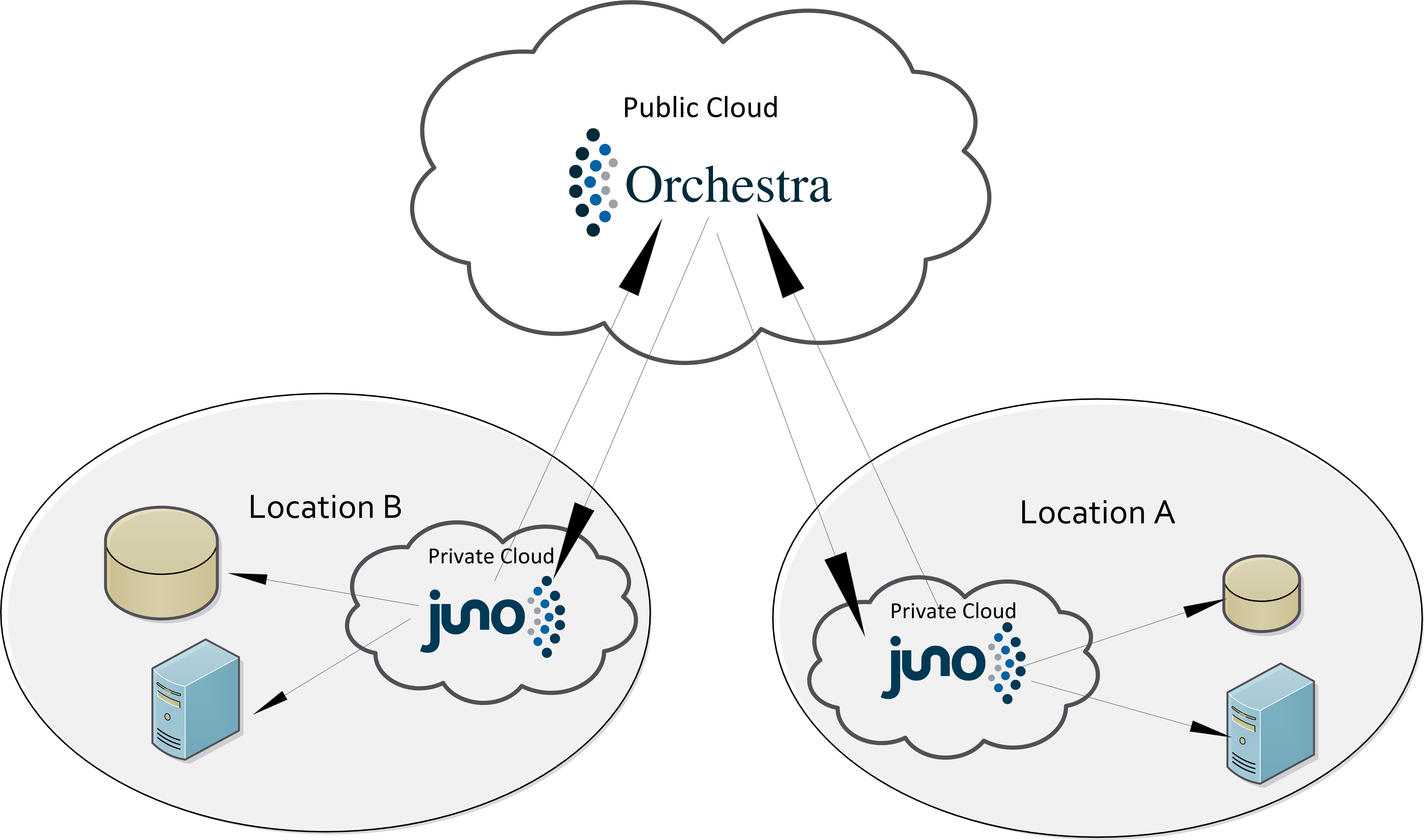
The picture shows an Orchestra node, running in a public cloud. The node is connected to two local networks, by Juno. This nodes may be installed in the local networks of different company locations. The processing of process models takes place in the Orchestra instance. Juno can connect foreign systems in the local networks to Orchestra. It manages the over network communication. For a better understanding the following picture gives a deeper view in the Orchestra architecture in context of Juno processing. The picture shows Orchestra, which connects three Juno instances.
As you can see the communication works via a proxy adapter instance. Every outsourced channel communicates by its own proxy instance with the main Orchestra. The communication is realized by an Orchestra internal protocol and uses a secure TLS connection. The usage of the system is very simple and explained in monitor documentation of cloud environment. The Orchestra functionality like persistence, triggering, signals, processs execution etc, works in normal behavior. Only the channel processing is outsourced to another component.
For a complete architecture explanation the following picture shows the local instance, Juno:
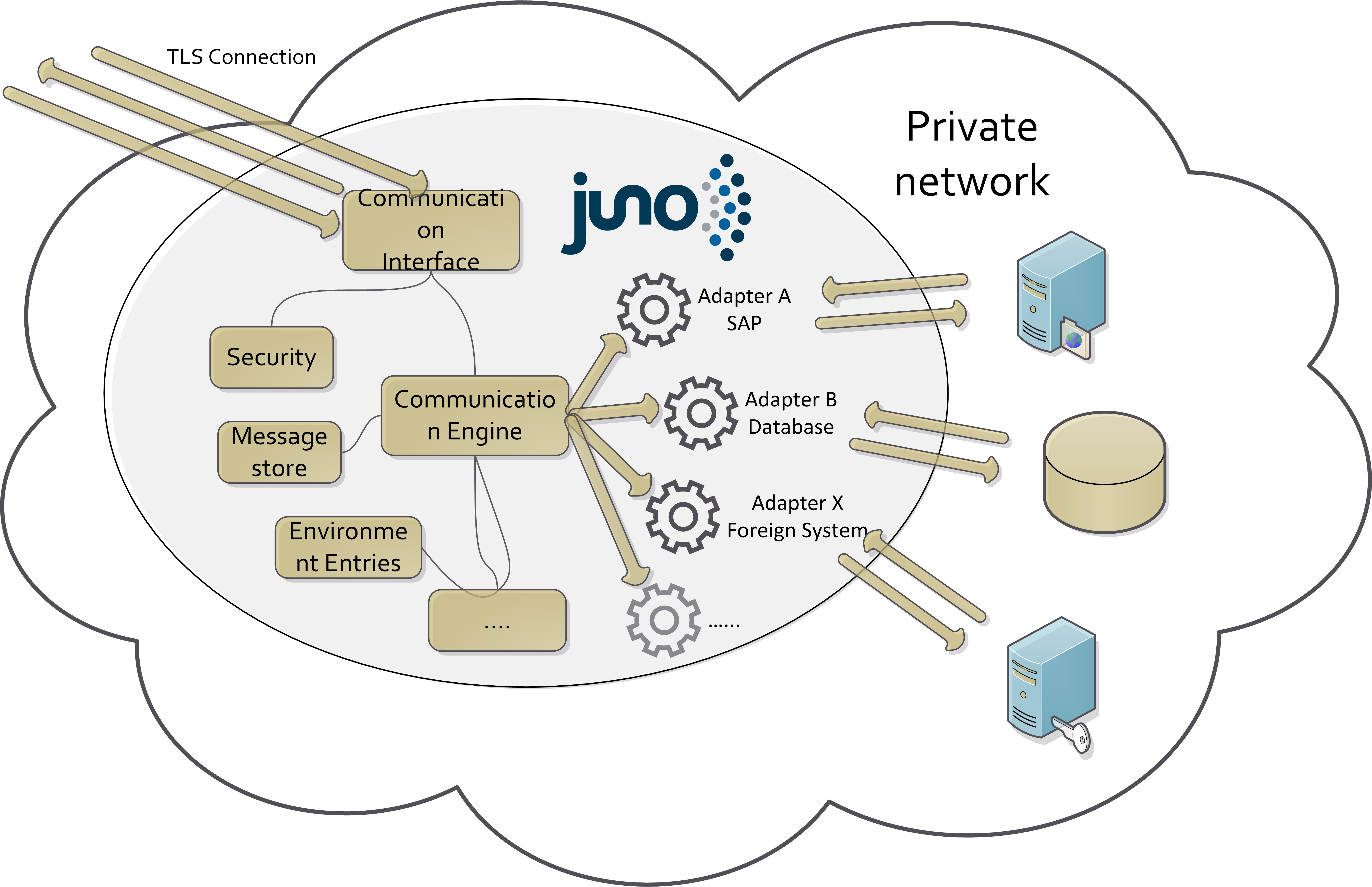
Juno is a minimized version of Orchestra that is capable service channels as well as serving process models and all configurations known from Orchestra.The component initializes the connection to Orchestra, which is the reason why the connection will be established even thought the private network has a firewall. After the initialization of the connection from Juno side, Orchestra is also able to send information, the communication works bidirectional. Another important benefit of this component is its light weightiness. It don't need any database or framework, except a java installation. Juno is a self contained app that can be started without any installation. Only a proper Java Environment is necessary.